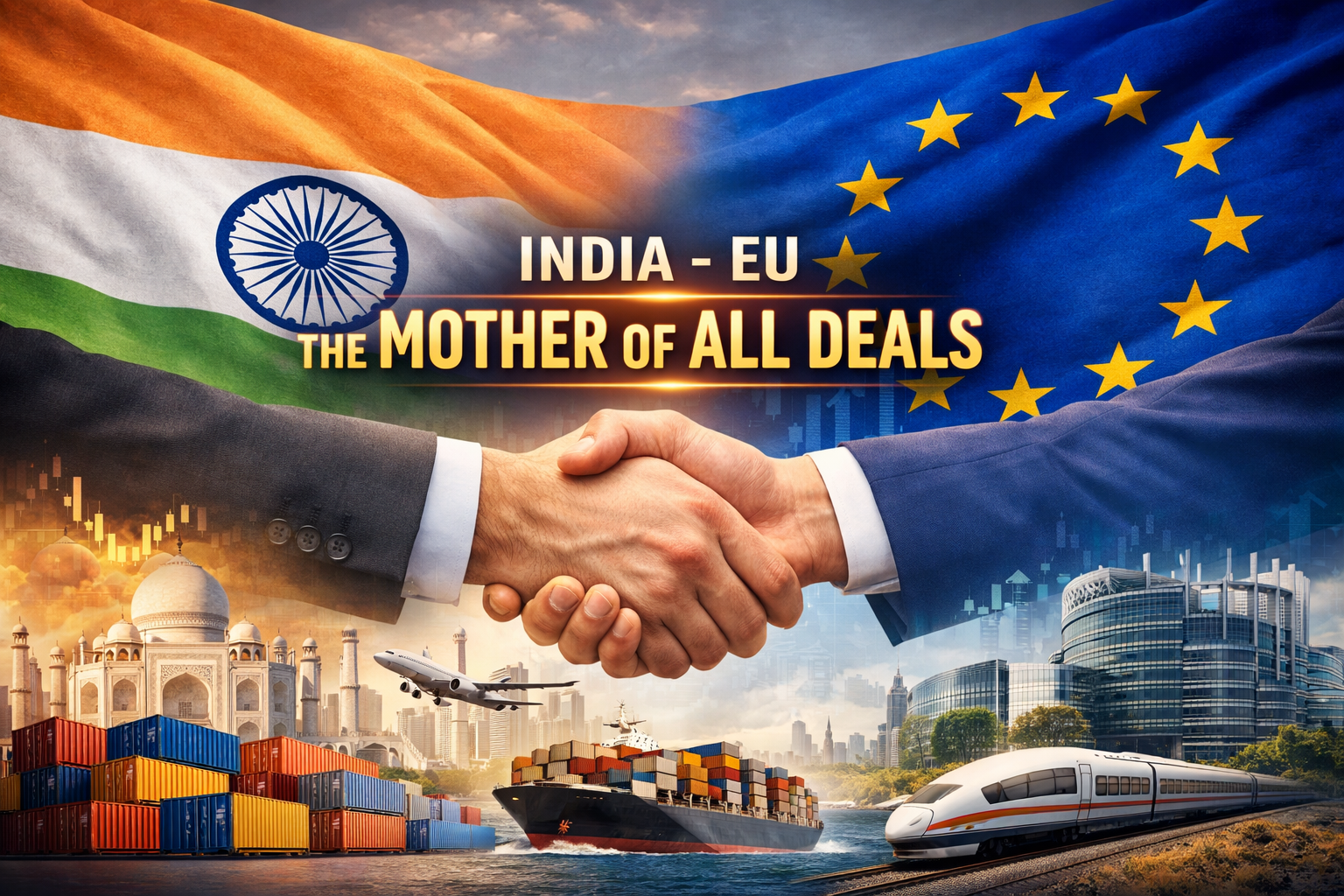
India and EU Set for the “Mother of All Deals”
When diplomats call something the “mother of all deals,” you know it is not a casual coffee-table agreement. India and the European Union are negotiating one of the most ambitious trade partnerships of this decade. The proposed India-EU Free Trade Agreement (FTA) aims to reshape economic ties between two of the world’s largest markets.
This deal does not rely on hype. It stands on numbers, negotiations, and mutual necessity. If signed, it could influence global supply chains, digital trade, sustainability rules, and investment flows for decades.
Let’s break it down—without jargon, without exaggeration, and with facts that actually matter.
What Is the India-EU Trade Deal?
The India-EU trade deal refers to a comprehensive Free Trade Agreement, officially relaunched in 2022 after a long pause. Both sides are negotiating three parallel agreements:
- Free Trade Agreement (FTA)
- Investment Protection Agreement (IPA)
- Geographical Indications (GI) Agreement
The European Union is India’s third-largest trading partner, while India is a fast-growing strategic market for Europe. According to official EU data, bilateral trade in goods and services already exceeds €120 billion annually. Yet, trade barriers still exist on both sides.
This deal aims to reduce those barriers—carefully and realistically.
Why Is This Deal Being Called the “Mother of All Deals”?
The phrase did not come from social media hype. It emerged from EU trade officials describing the scale and complexity of negotiations.
Here’s why the label fits.
- India represents over 1.4 billion consumers
- The EU represents 27 advanced economies
- Both sides negotiate across goods, services, data, climate, and labor standards
Few trade talks involve this level of diversity, regulation, and economic weight. Even seasoned negotiators admit this deal tests patience and policy balance.
In short, it is not big because it sounds good. It is big because it is hard.
What Each Side Wants From the Deal
Trade negotiations succeed when expectations stay realistic. This deal reflects exactly that.
What India Wants
India seeks:
- Greater access for IT services, professionals, and digital exports
- Lower tariffs on textiles, pharmaceuticals, and engineering goods
- Fair treatment for generic medicines
- Recognition of Indian standards and certifications
India also wants policy space to protect sensitive sectors like agriculture and small industries.
What the European Union Wants
The EU focuses on:
- Lower tariffs on automobiles, wine, and spirits
- Strong rules on environment, labor, and sustainability
- Data protection aligned with EU privacy standards
- Predictable rules for European investors
Neither side expects a one-sided win. That realism keeps negotiations alive.
Why This Deal Matters to the Global Economy
This agreement goes beyond India and Europe.
Global trade is shifting. Supply chains are diversifying. Countries want reliable partners, not just cheap ones.
India offers scale and growth.
Europe offers technology and regulation experience.
Together, they create an alternative to over-dependence on any single global manufacturing hub. That balance matters in a world shaped by disruptions, from pandemics to geopolitical tensions.
In practical terms, this deal could influence how future trade agreements handle digital trade, green standards, and inclusive growth.
Key Sectors Likely to Benefit
Not every sector will cheer equally, but many stand to gain.
Information Technology and Services
India’s IT and professional services sector could gain improved access to European markets. Easier mobility rules would help skilled professionals work across borders legally and transparently.
Manufacturing and Industrial Goods
Lower tariffs can make Indian engineering goods more competitive. European manufacturers could also benefit from streamlined supply chains linked to India’s production base.
Pharmaceuticals and Healthcare
India remains a major supplier of affordable medicines. Clearer rules could strengthen trust without compromising quality standards.
Green Technology and Sustainability
The EU leads in climate regulation. India leads in renewable expansion. Cooperation here supports global climate goals—without greenwashing.
What Are the Biggest Challenges?
No serious deal comes without friction.
Tariff Sensitivities
India maintains high tariffs in certain sectors. The EU expects gradual reductions. Negotiators must balance domestic interests with long-term gains.
Environmental and Labor Standards
The EU insists on enforceable sustainability commitments. India prefers flexibility aligned with its development needs. This remains a sensitive discussion.
Data Protection and Digital Rules
Data flows drive modern trade. Aligning India’s evolving data laws with EU expectations requires careful legal coordination.
These challenges slow progress, but they also prevent weak agreements.
Is the Deal Close to Completion?
Negotiations are ongoing, and officials on both sides avoid artificial deadlines. That approach builds credibility.
Trade agreements of this scale often take years. Speed matters less than durability. A rushed deal breaks easily. A balanced deal lasts.
Both India’s Ministry of Commerce and the European Commission have publicly reaffirmed commitment to reaching a fair, ambitious, and mutually beneficial agreement.
That consistency signals intent—not delay.
Why Businesses Are Watching Closely
Businesses dislike uncertainty more than strict rules. This deal promises clarity.
- Predictable tariffs
- Transparent regulations
- Dispute resolution frameworks
For startups, exporters, and investors, those factors matter more than headlines.
If signed, the agreement could unlock long-term planning rather than short-term speculation.
What This Means for Ordinary Citizens
Trade deals sound abstract, but they affect daily life.
- More product choices
- Competitive pricing
- Job creation in export-linked sectors
- Stronger consumer protection standards
No deal fixes everything. But smart trade agreements quietly improve economic stability over time.
And yes, cheaper cheese and better software can coexist.
Final Thoughts: Big Deal, Bigger Responsibility
The India-EU trade deal earns its dramatic nickname not because of political slogans, but because of its scale and consequences.
Both sides understand the responsibility. That awareness shows in cautious optimism, not loud promises.
If completed well, this agreement could set a benchmark for balanced, modern, and responsible trade in a fragmented global economy.
Sometimes, the real power move is patience.
Trusted Sources (For Transparency & E-E-A-T)
- European Commission – Directorate-General for Trade
- Ministry of Commerce & Industry, Government of India
- Official EU-India Trade Negotiation Briefings
- World Trade Organization (contextual trade frameworks)